Sonos Radio Stream Checker
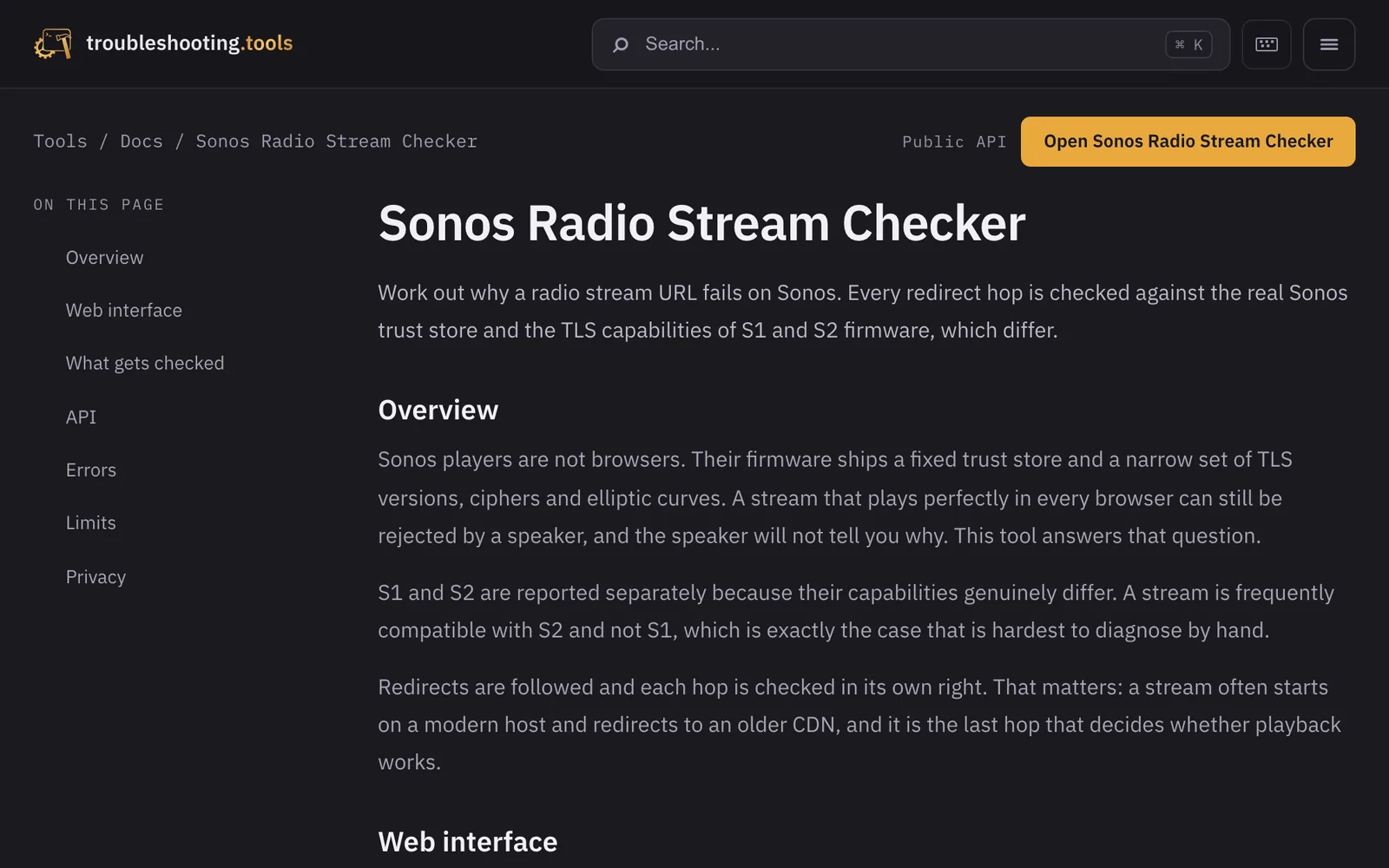
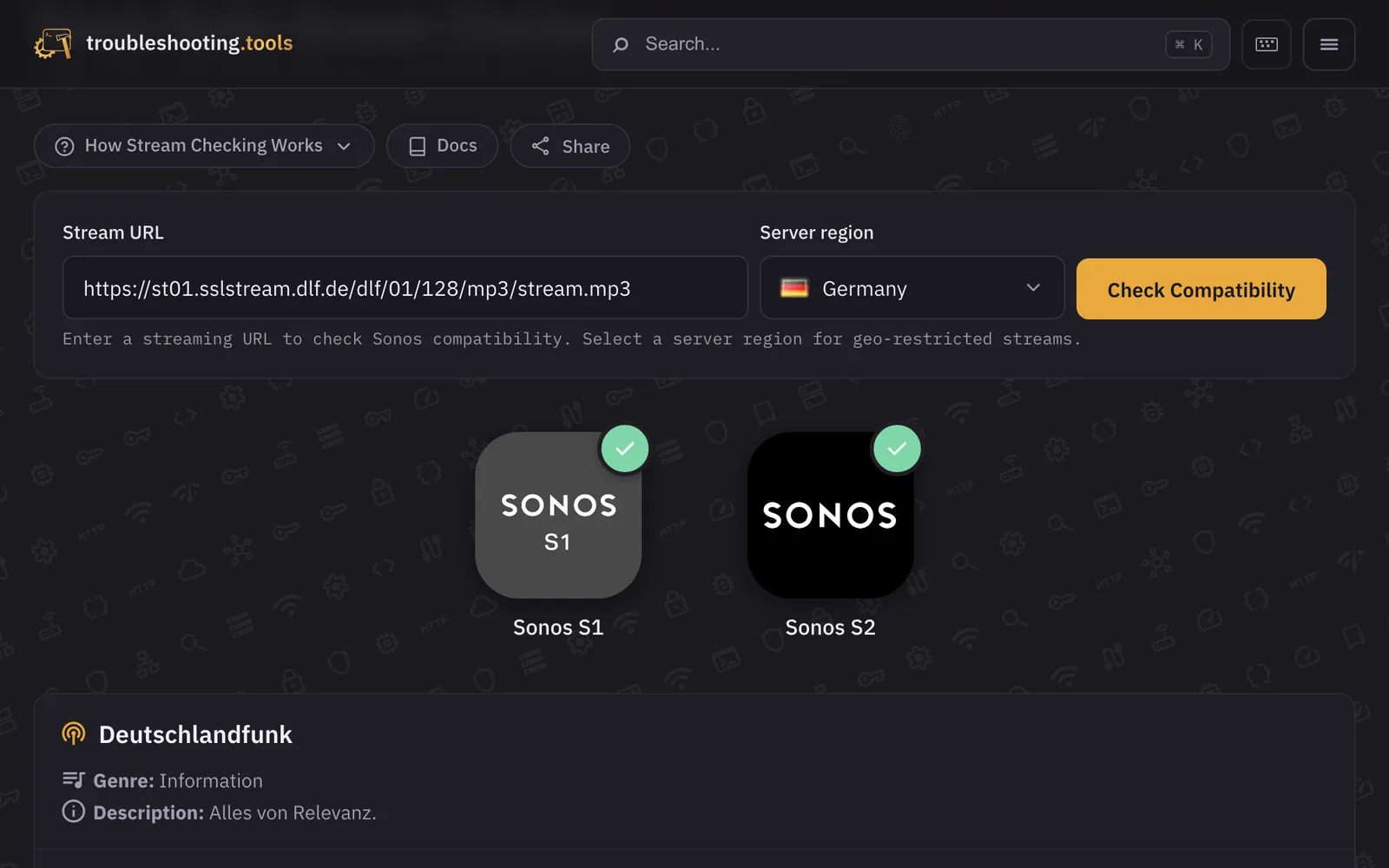
Separate verdicts for Sonos S1 and S2: every redirect hop checked for TLS, certificate and audio format, against the trust bundle the players download themselves.
Since
2020
Part of
troubleshooting.tools
Technologies
The Challenge
A stream that plays in the browser is far from guaranteed to play on Sonos. The players require IPv4, TLS 1.2 or newer, specific cipher suites and curves, limit redirects and trust only their own root certificates. If an intermediate certificate is missing, the browser does not notice because it already has it, but the player does. And S1 and S2 behave differently.
The Solution
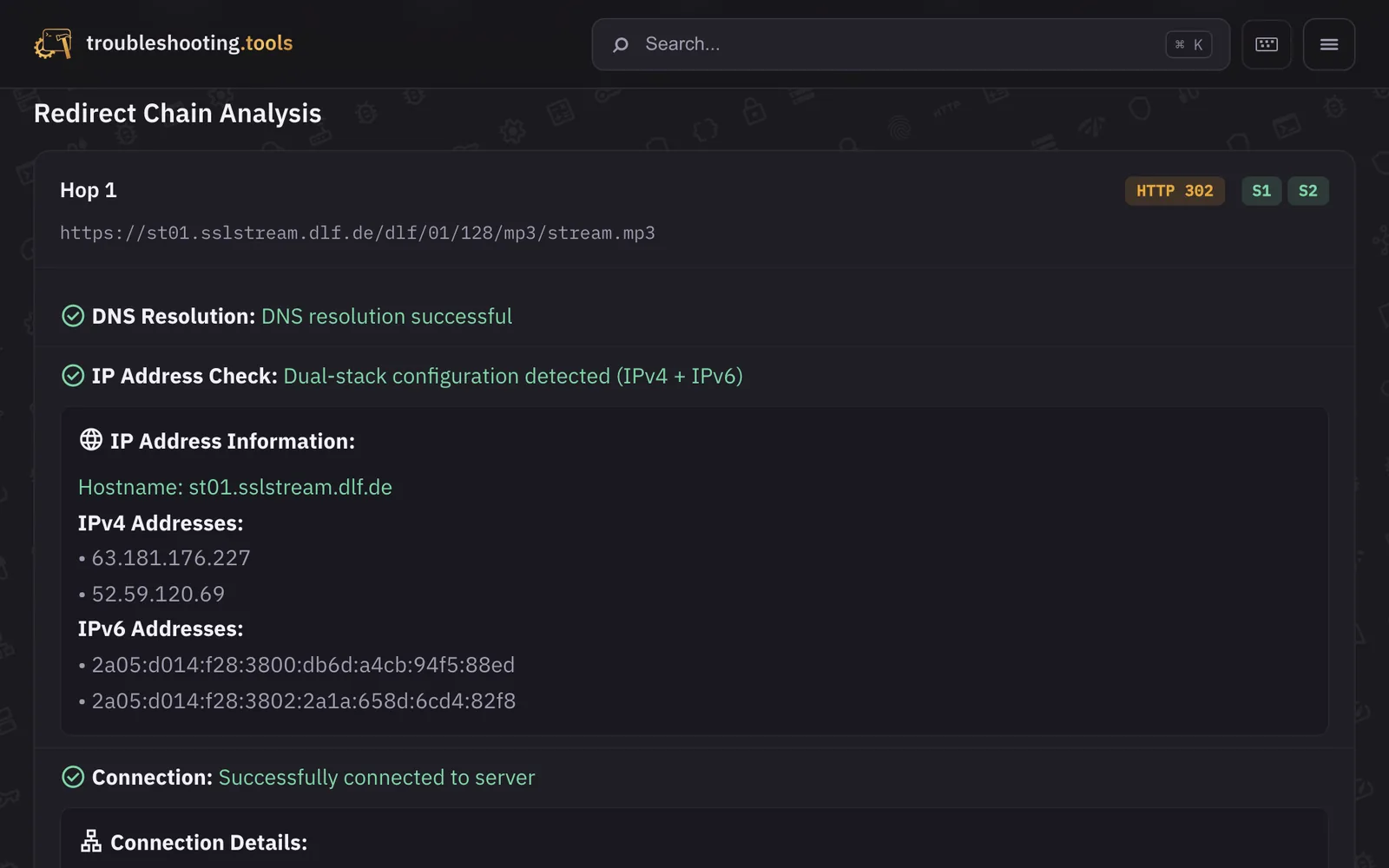
The tool checks every hop of the redirect chain separately, the way the player fetches it, and gives separate verdicts for S1 and S2. Trust is checked against the published bundle the players download themselves, by fingerprint. Failed handshakes are explained with the real reason, and the audio format is determined from the first bytes of the stream.
What is checked per hop
Connection
DNS resolution, IPv4 requirement (an IPv6-only host fails), connection with a plain-language error for 401, 403, 404, 5xx, timeout or refused connection.
TLS and certificate
Every TLS version from 1.0 to 1.3 probed separately, pinned at both ends and confirmed by two independent signals. Six ECDHE suites, curves P-256 and P-384, certificate chain, expiry, name match and the Sonos trust status.
Audio and metadata
Content-Type, ICY headers with station name, genre, bitrate and sample rate, plus the first kilobytes of audio. ffprobe determines codec, sample rate and channels; the format is checked against MP3, AAC, FLAC, OGG and WMA.
Redirects, playlists and regions
The redirect chain is checked against the hop limit Sonos players enforce. M3U and PLS playlists are parsed, and their first stream is checked as a request of its own with its own redirect chain, the way the player does it. Every redirect and playlist entry goes through the same SSRF guard as the submitted URL. Checks can run from Germany, the US, the UK or France to detect geo-restricted streams. Outbound connections are guarded and fail closed.
Trust like the player
The basis is the published trust bundle Sonos players download, fetched with verification, cached for 30 days and matched by SHA-256 fingerprint. If it cannot be fetched, a maintained list of roots is used. Missing intermediates are detected, and failed handshakes are named with the OpenSSL reason: missing intermediate, unknown root, expired, self-signed or name mismatch.
Platform and operations
The tool runs on the same platform as every tool on troubleshooting.tools: plain PHP behind nginx in one Docker image, a shared layout and router, a strict Content Security Policy per route and no CDN. GitLab CI tests every branch, builds the images with Docker-in-Docker and deploys them; structured logs and external uptime checks monitor operations.
Privacy
The check runs from the server; the stream provider sees the server, not the visitor. For the rate limit only a keyed HMAC of the address is stored. The checked URL, the region and the verdicts appear in the server log. Audio bytes are written only briefly to a temporary file for ffprobe and deleted right away. The page loads nothing from third parties; even the Sonos logos are self-hosted.
Results
A checker that names the typical reasons why a stream does not play on Sonos, separately for S1 and S2 and for every hop of the chain, instead of just reporting “does not work”.
Gallery
Screenshots of the public site with example targets.