Security Headers Check
HTTP security headers with a grade from A+ to F, every check explained in plain words, and repeated headers judged the way browsers read them.
Since
2026
Part of
troubleshooting.tools
Technologies
The Challenge
Many header checkers read headers naively: if a proxy and the application both send the same header, the grade comes out wrong. The first version of this tool graded troubleshooting.tools itself B instead of A for exactly that reason. On top of that comes the risk of any service that fetches foreign URLs: it must not be steered into a private network through redirects.
The Solution
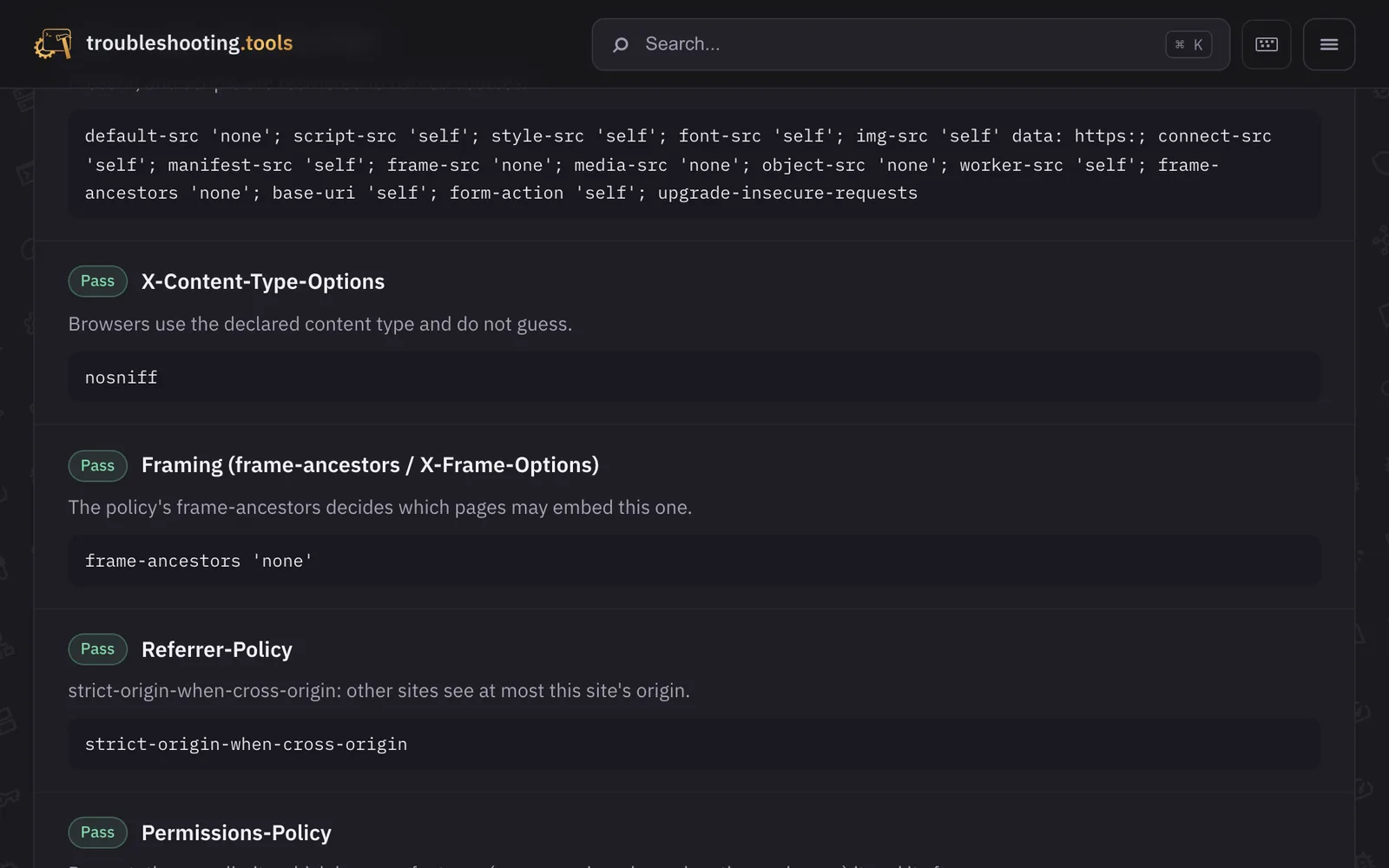
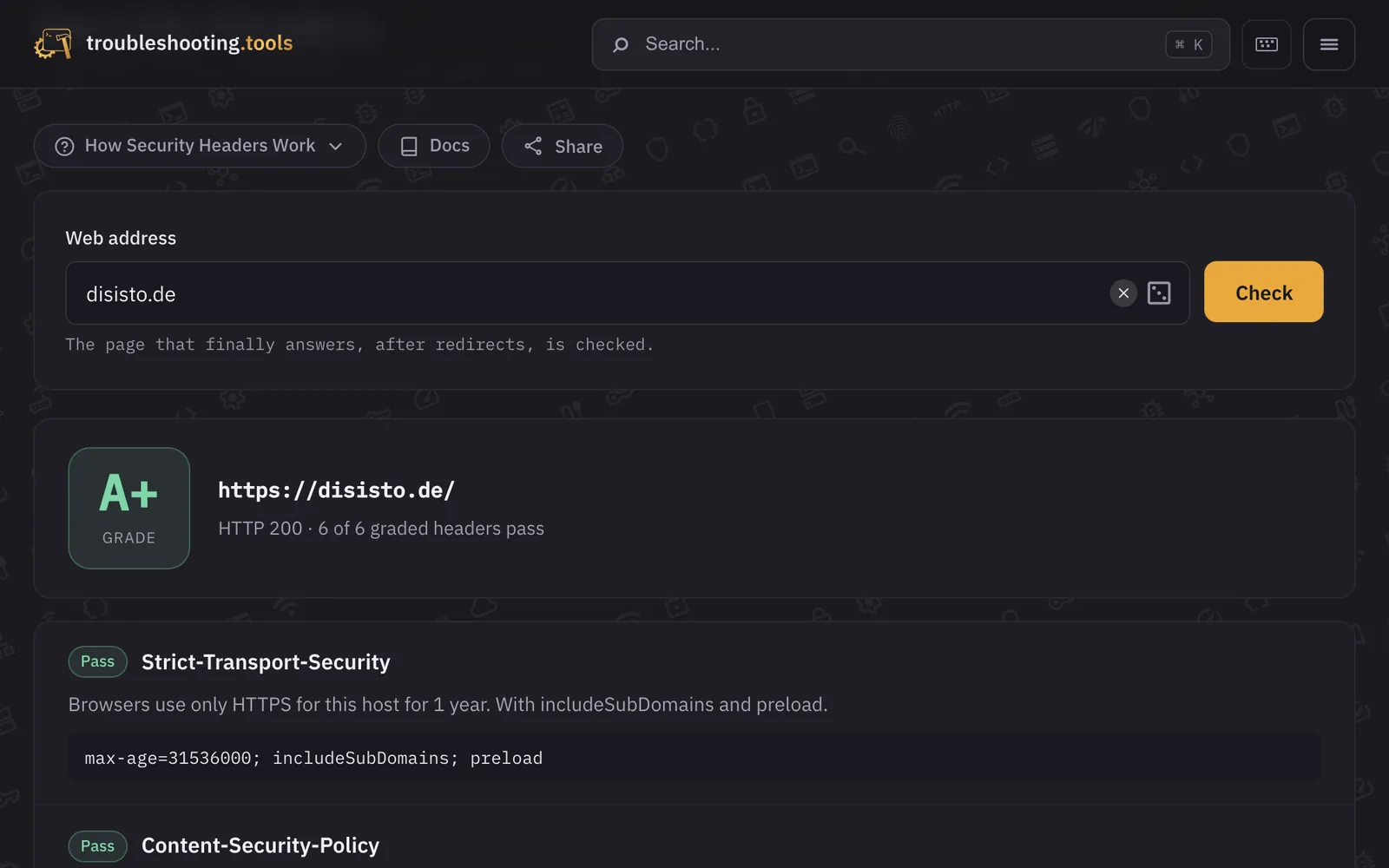
Every header is judged by the rule the browser applies to it, and the interface marks headers that were sent twice. The check explains in plain words what a header does or what is missing. The server reads only the headers, never the page body, and checks every redirect hop again for a public target.
What is graded
Six weighted headers
Strict-Transport-Security (at least 180 days), Content-Security-Policy, X-Content-Type-Options, framing, Referrer-Policy and Permissions-Policy. A pass counts one point, a warning half.
A+ and notes without weight
A+ means A plus a valid Cross-Origin-Opener-Policy and no software version in the headers. Reported but not graded: CORP, software versions, cookies without Secure, HttpOnly or SameSite, and X-XSS-Protection with a value other than 0.
Repeated headers read correctly
HSTS: only the first header. CSP: every policy is enforced, the strongest counts. X-Frame-Options as a set, Referrer-Policy the last recognised value, two COOP values count as not set.
Fetch with SSRF protection
The server follows up to five redirects. Every hop is resolved once, all addresses must be public IPv4, only standard ports are allowed, and the connection goes to exactly the address that was checked. The fetch stops at the first byte of the body; only the headers are read. An untrusted certificate ends the check with a pointer to the SSL/TLS test. Outbound connections are guarded and fail closed.
Standards
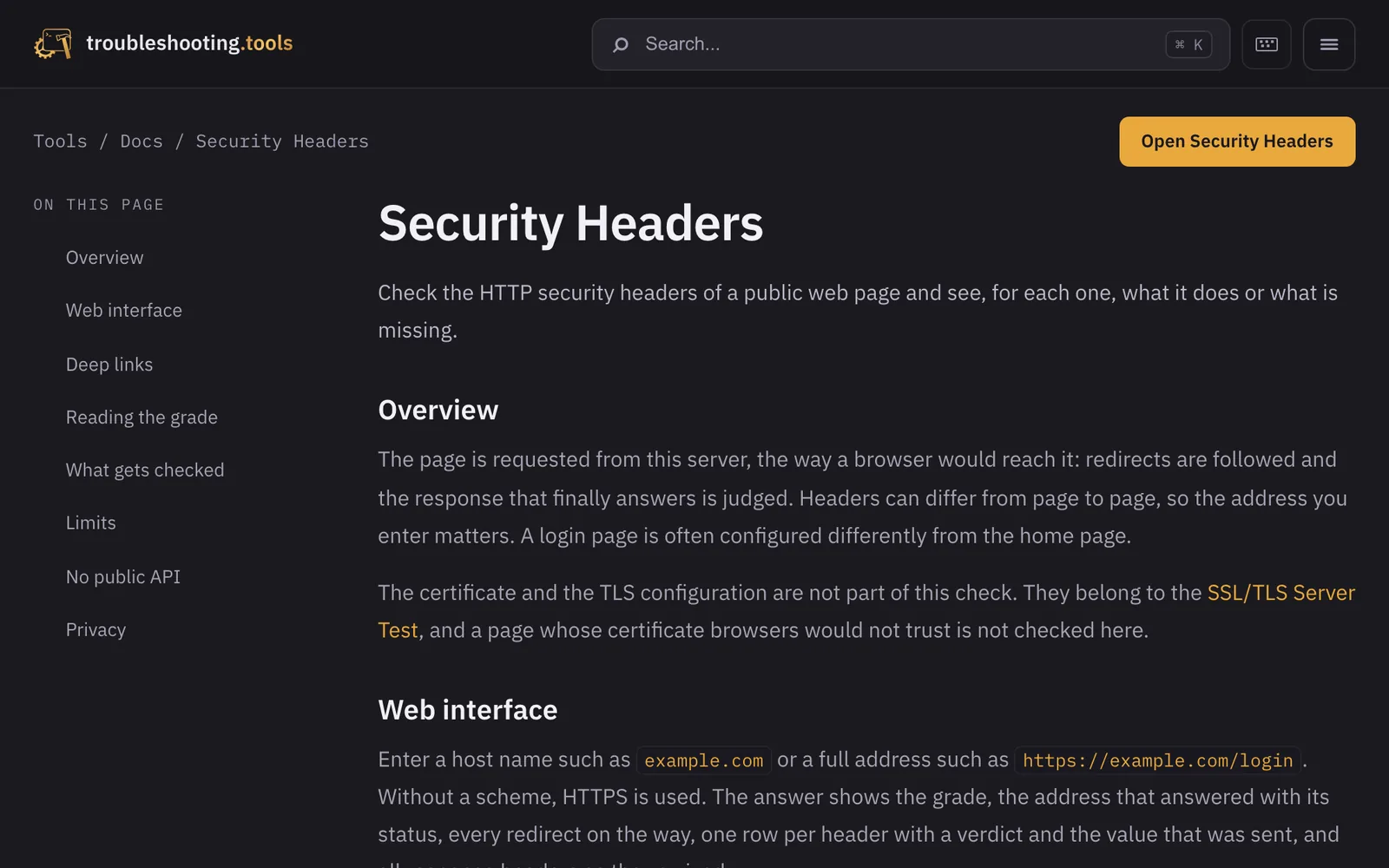
The rules follow RFC 6797 for HSTS, the Fetch standard for X-Content-Type-Options and CORP, HTML for X-Frame-Options and the opener policy, and the specifications for CSP, Referrer-Policy and Permissions-Policy. The server resolves names via DNS over HTTPS (RFC 8484) before each hop. Stable links such as /check/headers/disisto.de start the check directly; there is no public API.
Platform and operations
The tool runs on the same platform as every tool on troubleshooting.tools: plain PHP behind nginx in one Docker image, a shared layout and router, a strict Content Security Policy per route and no CDN. GitLab CI tests every branch, builds the images with Docker-in-Docker and deploys them; structured logs and external uptime checks monitor operations.
Privacy
The checked site never sees the visitor's address. For the rate limit only a keyed HMAC-SHA256 of the address is stored. The checked URL and the grade appear in the server log. Nothing else is stored, there is no result cache, and the page sets no cookies and loads nothing from third parties.
Results
A header checker that grades the way browsers actually decide and explains every grade, without becoming an entry point itself.
Gallery
Screenshots of the public site with example targets.