MAC Address Vendor Lookup
Vendor, registry type, block size and address range for any MAC address from the IEEE registries, for single addresses, whole ARP tables or through the API.
Since
2021
Part of
troubleshooting.tools
Technologies
The Challenge
The first half of a MAC address tells which organisation registered the block with the IEEE. Many lookup sites only check the classic six-hex-digit OUI table. For the smaller MA-M and MA-S blocks they then name the wrong vendor, or “IEEE Registration Authority”. Randomised addresses from phones and laptops, multicast or broadcast simply end up as “not found”.
The Solution
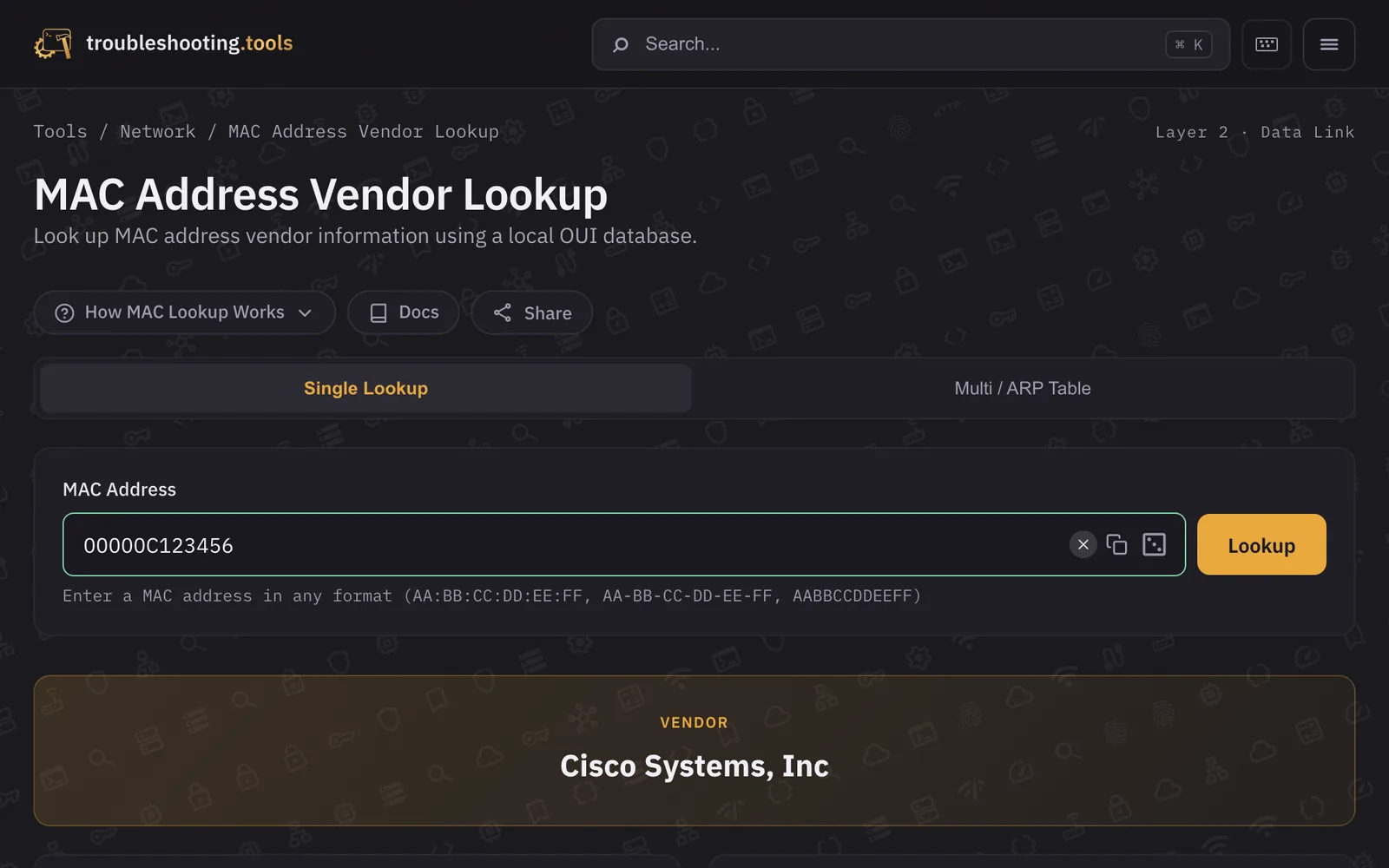
The tool mirrors all five public registries of the IEEE Registration Authority locally and searches for the longest matching prefix. It names vendor, registered address, registry type, block size and the first and last address of the block. Special addresses are explained with their standard instead of being left blank. Single addresses work just like whole ARP tables, and every result has a stable link.
How matching works
Input in any notation
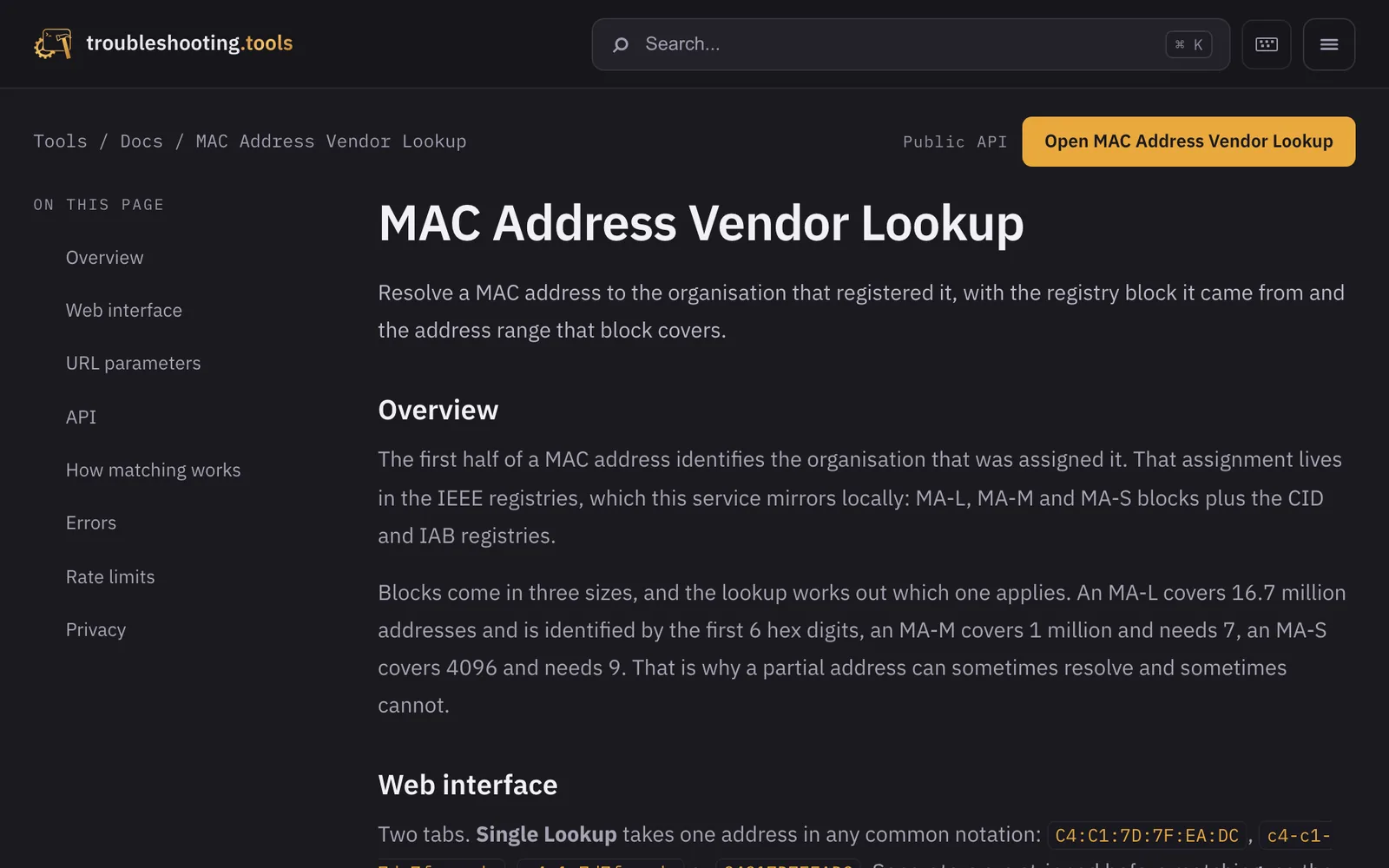
Colons, hyphens, Cisco dots or nothing at all: separators are stripped before matching. A prefix alone is enough when it has enough hex digits for its block.
Longest prefix first
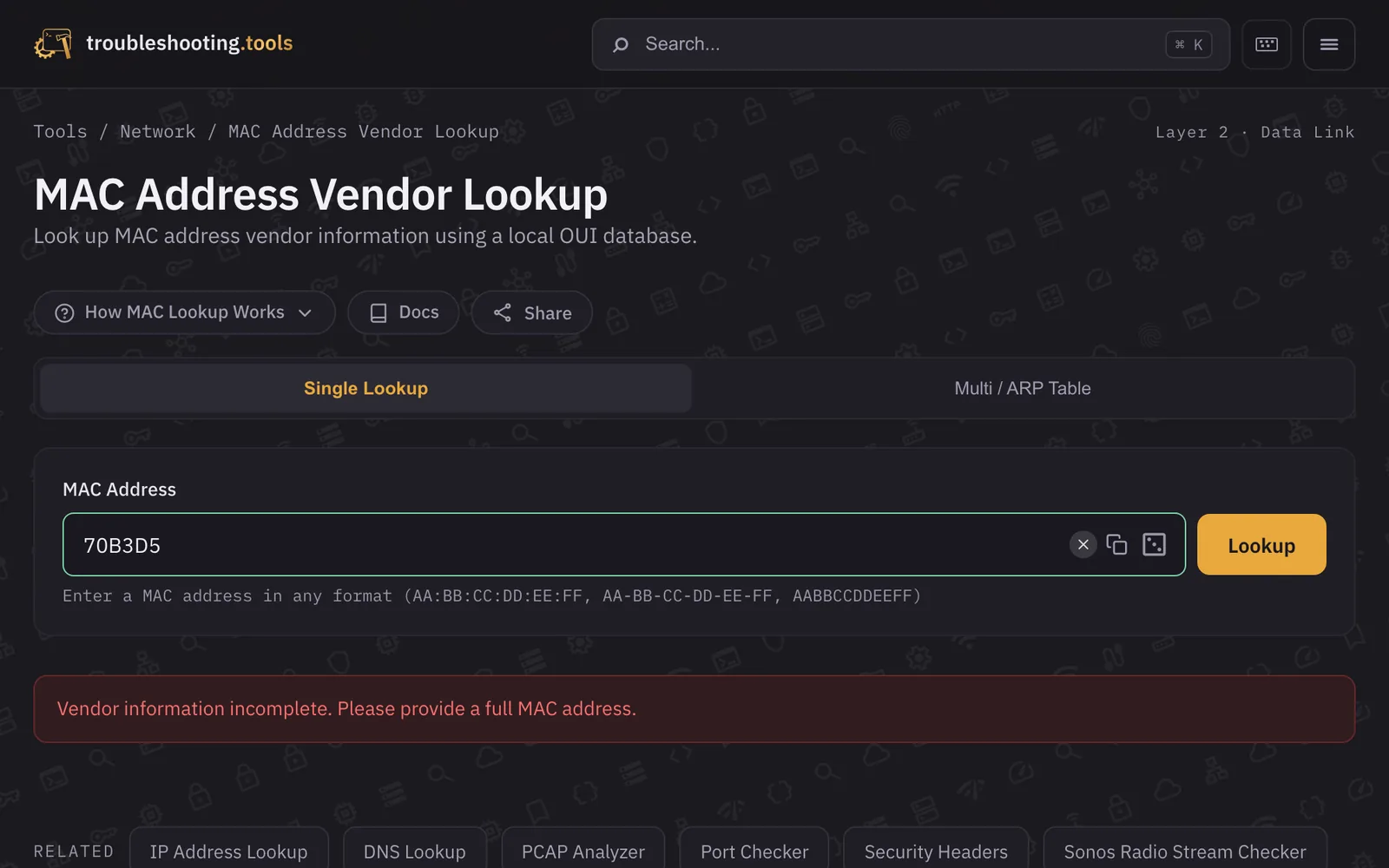
First 9 hex digits (MA-S), then 7 (MA-M), then 6 (MA-L), plus CID and IAB. Small blocks sit inside a parent block the IEEE keeps for itself. If only that one matches, the tool says honestly that the information is incomplete instead of naming the wrong vendor.
Special and randomised addresses
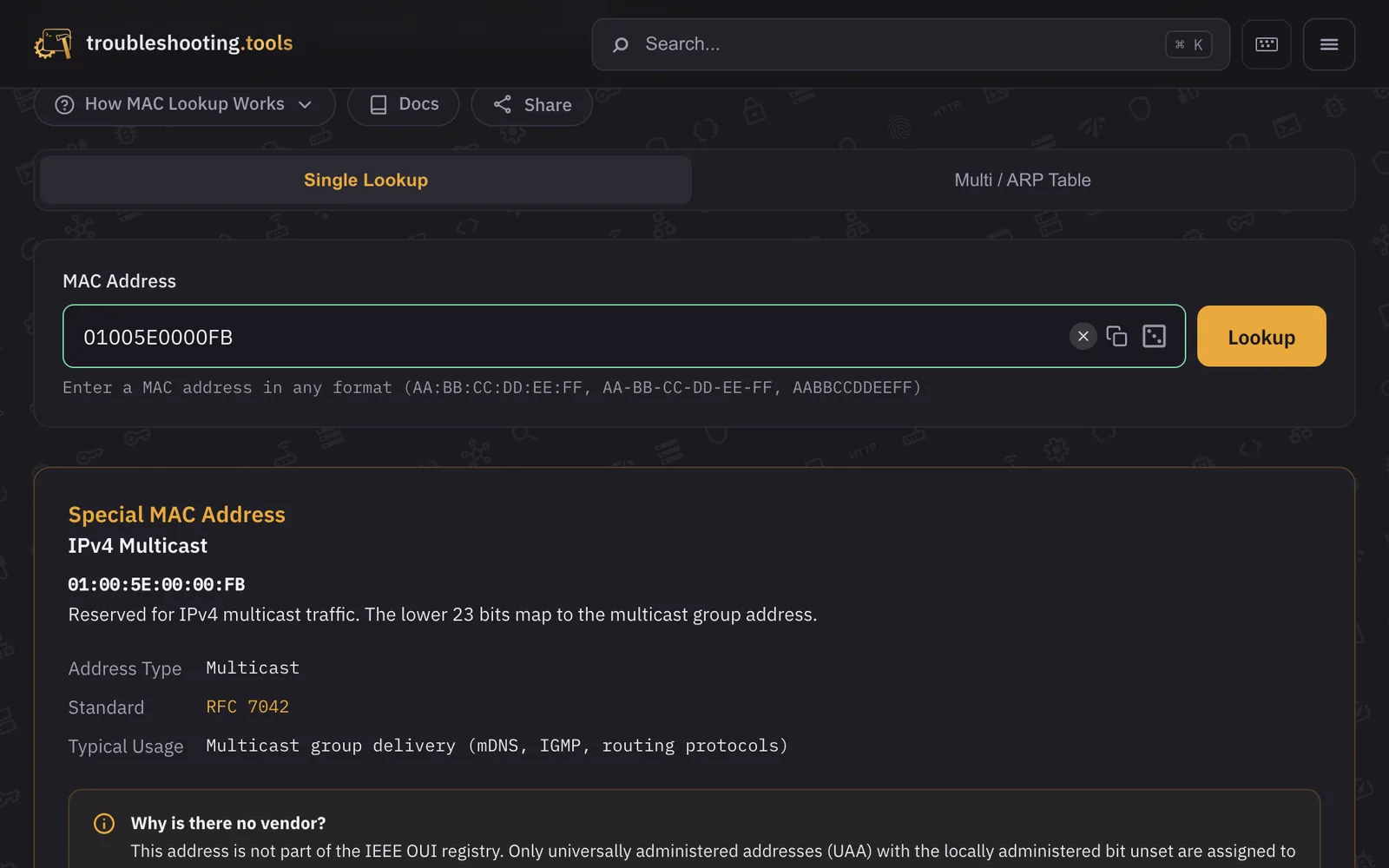
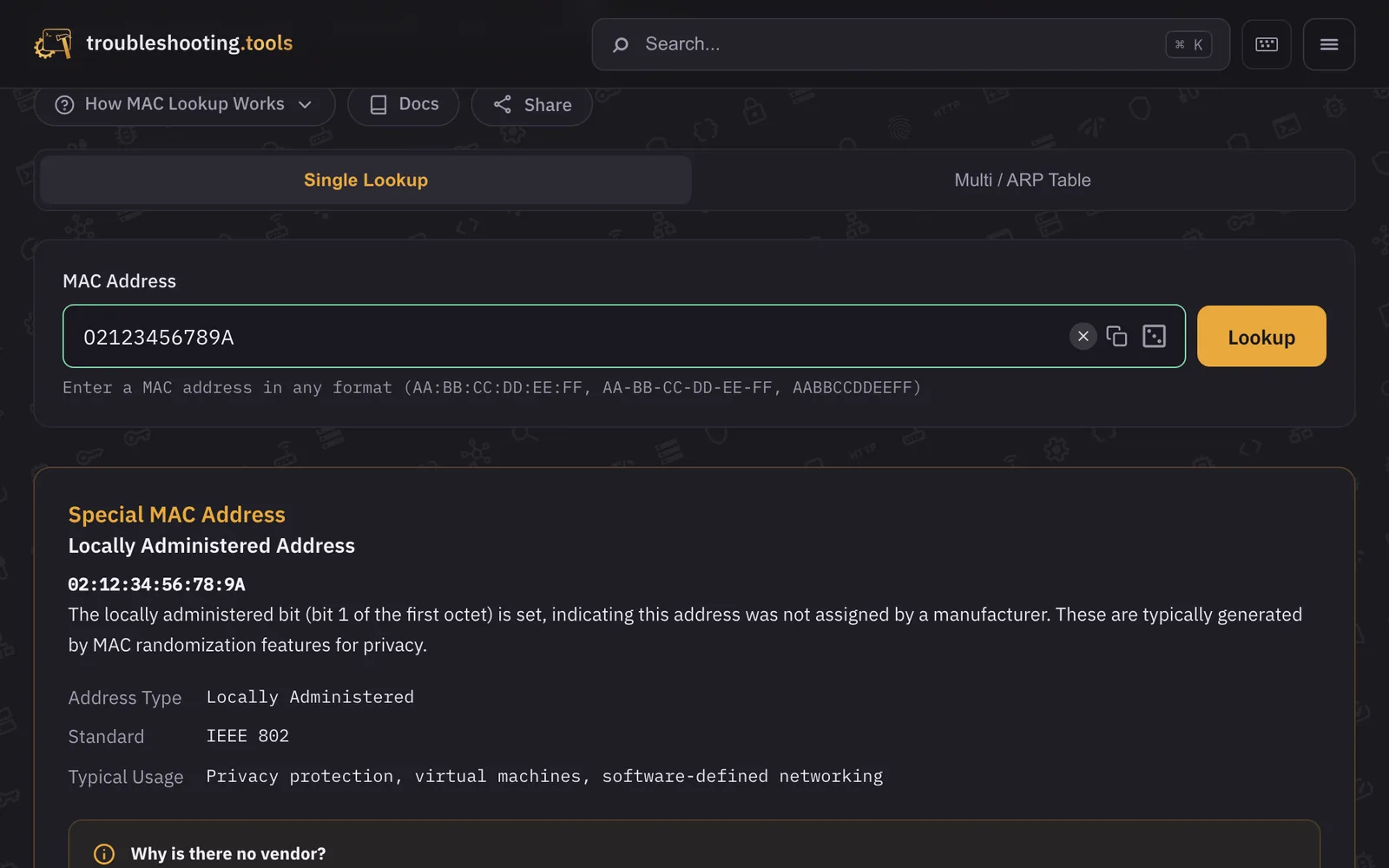
Broadcast, IPv4 and IPv6 multicast, Spanning Tree, LLDP and the all-zeros address appear with their standard. If the U/L bit is set, the page explains that it is usually a randomised address from a phone or laptop.
Data sources
The source is the five public registries of the IEEE Registration Authority: MA-L (OUI), MA-M, MA-S (OUI-36), CID and IAB. A scheduled job mirrors them into PostgreSQL once a month, so a lookup never asks the IEEE live. The import aborts if a registry has too few lines, runs in a single transaction and reports failures. Entries that disappear from the registries are marked as removed instead of deleted and are no longer used for matching.
Batch API
The API works without a key or account. It answers as JSON, always an array, or as plain text with just the vendor name for scripts. Several addresses go comma-separated into one request. Errors are reported per address inside the array at HTTP 200; only a database failure answers 500. The rate limit applies per address and responds with HTTP 429.
Whole ARP tables
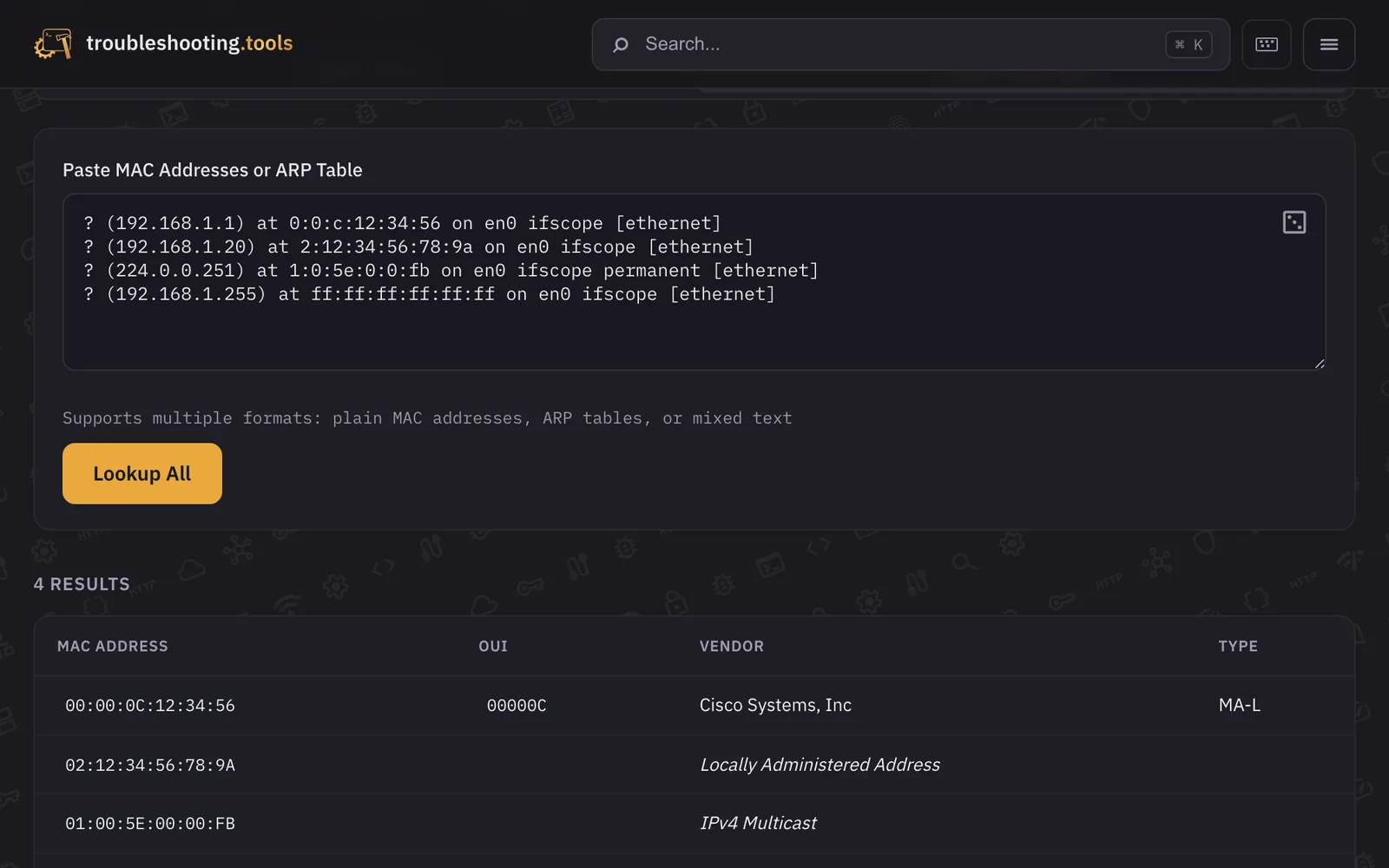
In the “Multi / ARP Table” tab you can paste raw output from arp -a or ip neigh on Linux, macOS and Windows. The tool pulls out the MAC addresses and ignores the rest, including macOS's shortened notation without leading zeros. The result is a table with vendor and type for every address.
Architecture and operations
The tool runs on the same platform as every tool on troubleshooting.tools: plain PHP behind nginx in one Docker image, a shared layout and router, a strict Content Security Policy per route and no CDN. A lookup is purely server-side and makes no outbound request; data comes only from the local database. GitLab CI tests every branch, builds the images with Docker-in-Docker and deploys them; structured logs and external uptime checks monitor operations.
Privacy
There are no accounts. Queried addresses appear in the server log like all queries; the documentation explicitly treats a MAC address as identifying data, even though only a public registry is read. Analytics only with consent through self-hosted Matomo. The map of the organisation's location loads only after explicit consent; until then the page makes no request to third parties.
Results
A simple OUI lookup from 2021 has become a tool that resolves all IEEE block sizes correctly, stays honest when information is incomplete and explains special addresses. It accepts whole ARP tables and returns the same data through an API for scripts.
Gallery
Screenshots of the public site with example addresses; the device part of the addresses is invented.